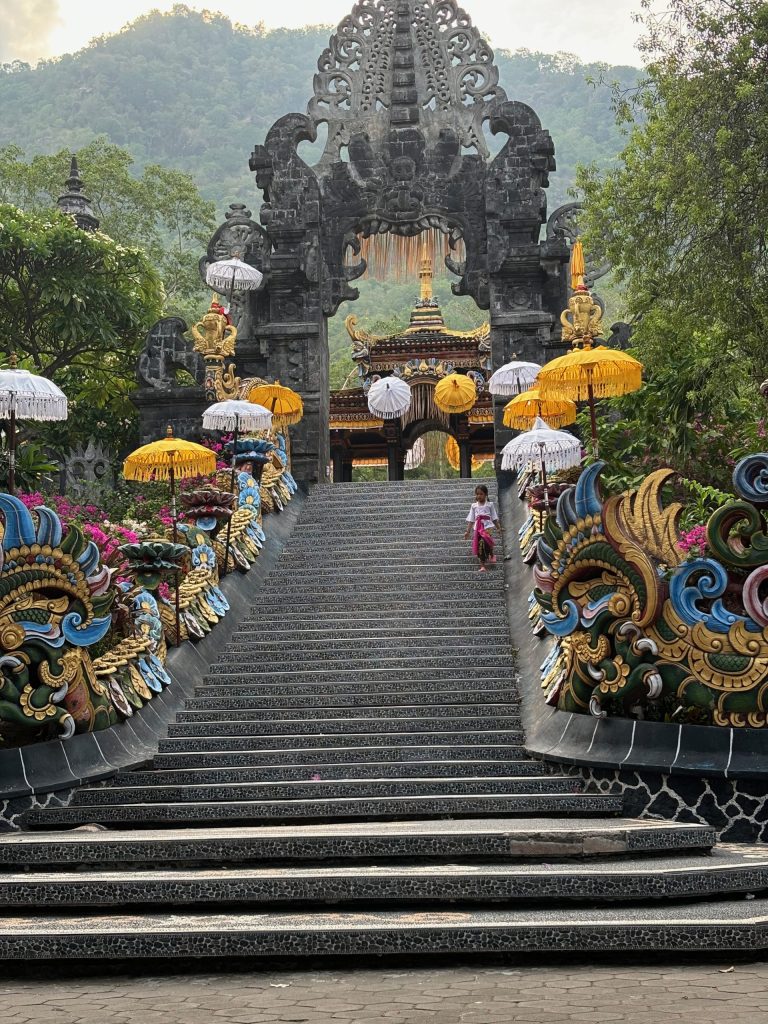
One day, I heard music coming from our beach. It sounded a little like a brass band. To the right of the villa, a large group of people had gathered in beautiful traditional clothing. There was so much happening, and naturally, I was curious.
Later, I learned that it was a cremation ceremony.
That wasn’t what I had expected from the music and the elaborate preparations. I watched respectfully from a distance. It was moving to see so many people coming together to say goodbye.
In Bali, ceremonies are part of life. I’ve been visiting for years, but they still touch me. Especially the togetherness. Families, neighbours, different generations: everyone belongs and helps out. I find that beautiful.
I love being in Bali for the full moon
Whenever possible, I plan my visits to Bali around the full or new moon.
The full moon is called Purnama, and the new moon Tilem. These are important days of prayer for Balinese Hindus. Offerings are made, and people pray at their family temple or visit a temple nearby.
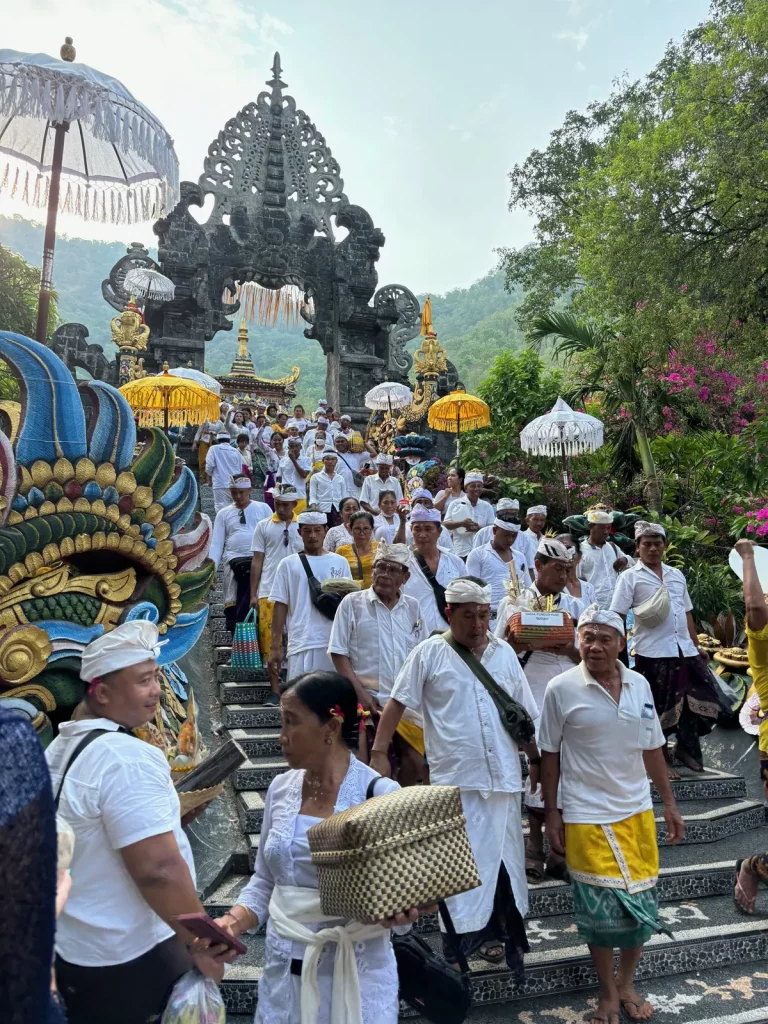
You see people wearing traditional clothing everywhere. Women in beautiful blouses and colourful wraps, men wearing their distinctive folded headcloths. That alone is a wonderful sight.
I love joining them when I’m invited. There I sit, among everyone, with my blonde hair. Over time, I’ve become familiar with the prayer and several customs, and I can follow more of what is happening. I feel that my genuine interest and thoughtful participation are appreciated.
I feel welcome. And although there is still so much I don’t know, I can feel how much the experience means to me.
What should you wear to a temple?
Appropriate clothing is part of attending a ceremony. It also adds to the special feeling of the occasion.
Women often wear a kebaya, a traditional blouse, with a kamen, a cloth wrapped around the lower body. A selendang, or sash, is tied around the waist. Hair is usually neatly arranged or tied up.
Men generally wear a shirt, a kamen, a sash and an udeng, the folded headcloth. Full ceremonial dress often includes an additional cloth called a saput or kampuh.
As a visitor, it’s best to ask beforehand what is appropriate for the occasion. Our driver or team can help you, as they know the local customs.
It’s also worth knowing that Balinese temple rules prohibit women who are menstruating from entering the sacred temple areas. Keep this in mind when planning your visit and follow the guidance given locally.
A beautiful temple for prosperity
I love visiting temples. Not only for the buildings, but especially for the atmosphere and the reasons people come to pray.
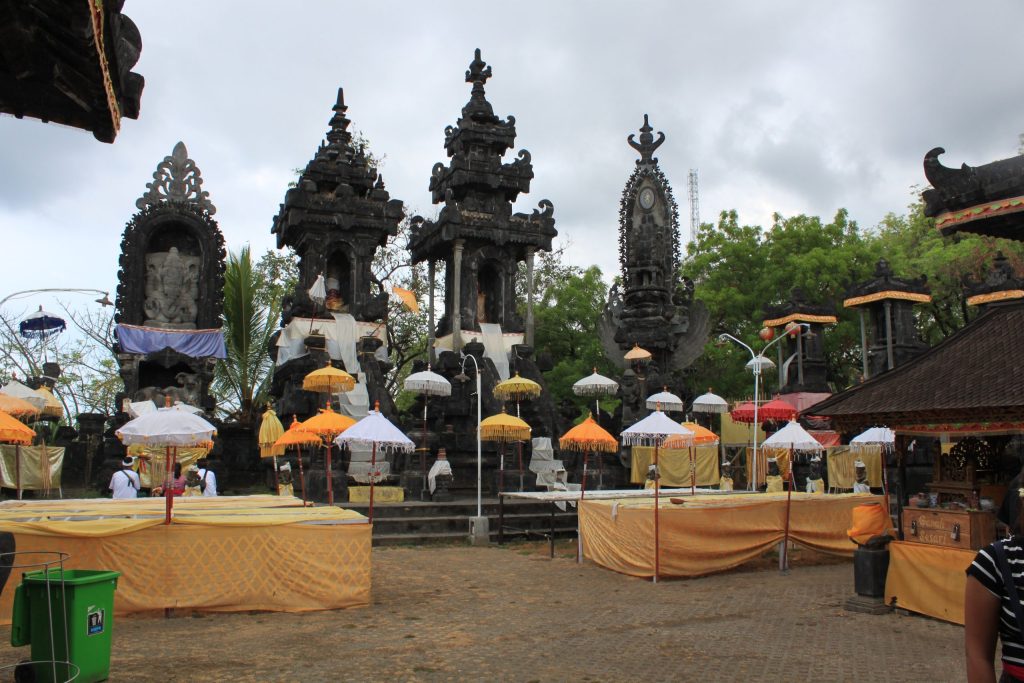
Further inland near Pura Pulaki is a beautiful temple where people pray for prosperity in business: successful trading, customers and a thriving company. I believe it is Pura Melanting, a temple near Banyupoh at the foot of the hills, known as a place of worship for traders and others.
I enjoy visiting this place. Next time, I’ll ask someone to confirm the name. Apparently, I remember the location better than the name!
A Balinese wedding brings families together too
A traditional Balinese Hindu wedding is called pawiwahan. Customs vary between families and places, but it is much more than a celebration for the couple.
There are prayers, offerings, purification rituals and blessings. Ancestors and family temples also play an important role. The marriage connects two people and their families.
During some wedding rituals, the couple acts out a small trading exchange, symbolising a wish for prosperity in their life together. Family members and the community help with the preparations and ceremony.
That is something I love about Bali. An important step in life is supported by the people around you. They prepare, help, pray and eat together.
And then there are the clothes. A couple in traditional wedding dress is truly beautiful to see.
From birth, a child is surrounded by ceremonies
A newborn child in Bali is welcomed through several rituals. Not every family follows exactly the same traditions. Names, timings and the size of a ceremony can vary.
What touches me is the care with which a child is guided through life. Birth and growing up are marked by moments when everyone pauses to recognise their importance.
These are some of the significant occasions that may be observed in Balinese Hindu families:
- At birth: the baby is welcomed, and the placenta is carefully buried according to family tradition. Within the belief system, it has a special connection with the child.
- When the umbilical cord stump falls off: the ceremony known as kepus pungsed focuses on protection and wellbeing.
- Around the twelfth day: some families hold ngelepas hawon, a purification and protection ritual.
- After 42 days: tutug kambuhan focuses on purification and the wellbeing of the mother and child.
- After 105 days: nelu bulanin, also called nyambutin, is the important “three-month” ceremony. These are three months according to the traditional calendar, rather than three ordinary calendar months.
- After 210 days: the first otonan celebrates the child’s birth according to the Balinese pawukon calendar. It then takes place every 210 days throughout life.
Some families also observe rituals for a child’s first haircut, first teeth and the loss of baby teeth. During adolescence, menek kelih or raja sewala may mark the transition into a new stage of life.
A well-known coming-of-age ceremony is metatah, also called mepandes. During this ritual, the two upper canine teeth and four upper front teeth are lightly filed. Its meaning includes self-control and learning to manage human qualities such as anger and desire. The timing varies, and it is sometimes combined with another major family ceremony.
There isn’t a fixed ceremony for every birthday up to the age of twenty. Instead, there are recurring moments when the family gathers to offer a child protection, guidance and good wishes.
I think that is a lovely idea.
Ice-cold water near Singaraja
I’ve also taken part in a purification ceremony near Singaraja. The spring water was ice-cold. Children played in the river while we joined the ceremony.
That combination has stayed with me. For me, it was a special experience, while everyday life continued all around us.
This kind of purification with sacred water is often called melukat. It can take place at springs, rivers and other sacred water sites. Within Balinese Hinduism, it carries a meaning of spiritual cleansing.
Afterwards, I genuinely felt refreshed and cleansed. I’m not quite sure how else to describe it. Calmer, lighter, as though I had let something go.
And the cold water? By then, I was quite happy to be out of it!
Something I sometimes miss in the Netherlands
For me, the magic of these ceremonies lies in the sense of connection.
People make time for one another. They help, prepare together and pause to recognise something important. Children grow up with these traditions, watching their parents and grandparents take part.
I sometimes miss that natural sense of togetherness in the Netherlands. Of course, we gather too, but in Bali I see and feel it so strongly.
Perhaps that is one of the reasons I feel so at home there. I come for the peace, the weather and the people, but also for those moments when I’m sitting among everyone and thinking: this is something special.
A special occasion during your stay?
At the bottom of our Discover North Bali page, you’ll find a calendar of special dates for the coming months, with a short explanation. Have a look when planning your holiday.
If you’re staying at Villa Bima Sena on a ceremony day and would like to experience it, ask our team or driver. They can explain where visitors are welcome and help you prepare.
In my experience, genuine interest is often warmly received. Join when you’re invited, let someone guide you and ask before taking photographs. Sometimes simply sitting quietly and watching is enough.
On my next visit, I hope to be sitting among everyone again. Wearing my temple clothes, with my blonde hair, and feeling a little more familiar with the prayer.
For me, that remains one of the most beautiful things about Bali.
Warm wishes,
Karin